
Buoyancy & ballast engineering guide
Buoyancy and ballast for custom ROV and AUV research platforms.
On a research vehicle assembled from a frame, pressure housings, thrusters and a changing set of sensors, buoyancy is a running total you track from the first design decision. Leave it to the end and it turns up as a vehicle that floats nose-down, sinks under a heavier payload, or has weights bolted on the night before a trial. This guide covers the net buoyancy calculation, choosing syntactic foam by depth rating, and trimming ballast on lab-built and small-batch ROVs and AUVs.
System-level weight budget
Calculating net buoyancy.
Net buoyancy is the upward force from the water your vehicle displaces minus the downward force of its weight in air. Teams almost always underestimate the weight. It includes the frame and the housings, and also every thruster, cable, fastener and small bracket added during the build. A mounting bracket or cable clamp weighs a few grams, but a research vehicle can carry dozens of them, and together they belong in the budget.
Build a weight table as you design: frame, housings with their trays and boards, thrusters, connectors and cables, and the payload, each with a measured or manufacturer-stated mass. Work out displaced volume the same way, part by part, from the outside dimensions of everything in the water. Aim for close to neutral with a small positive margin, typically a few hundred grams to a couple of kilograms depending on size. Then a power or thruster failure leaves the vehicle rising slowly for recovery, and the thrusters do not spend their effort holding it down in normal running.
Leave room in the budget for the next payload as well as the current one. Research payloads change between deployments: a camera swapped for a sonar head, a sampling module added, a bigger battery for a longer mission. A vehicle trimmed to the gram for one payload needs the ballast recalculated, and often new foam, every time that changes. Allowing for the next one or two payload changes now saves that work later.
Matching foam grade to operating depth
Syntactic foam selection by depth rating.
When the weight budget comes out heavy, make up the difference with syntactic foam. Sealed air spaces collapse at depth. Blu-Float solid buoyancy foam is high-strength epoxy filled with hollow glass microspheres and moulded under high pressure. It comes in grades rated to 500 m, 1,200 m, 1,500 m, 2,000 m, 3,000 m and 6,000 m. Density rises from about 0.36 to 0.57 g/cm³ across the grades, and minimum compressive strength from 12 MPa to 70 MPa. Water absorption is 1% or less for every grade. A standard block is 500 × 500 × 100 mm and weighs about 8.95 kg in the 500 m grade and about 14.55 kg in the 6,000 m grade.
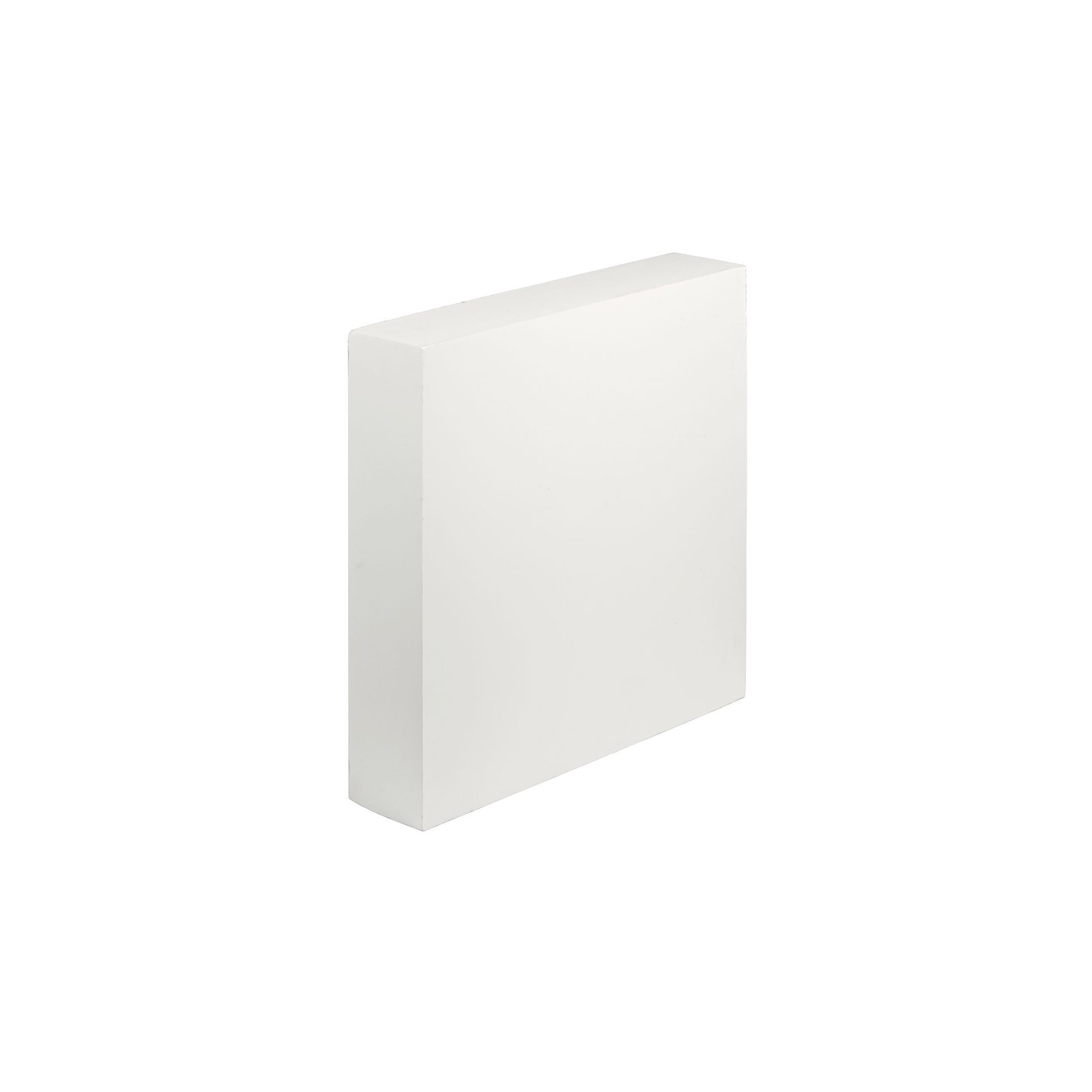
That spread in density is the trade-off. The lighter, shallow grades give more lift per kilogram of foam. The denser, deep grades give less lift per kilogram, but survive the pressure at depth without absorbing water and losing buoyancy over repeated dives. Specify foam for the vehicle's maximum working depth plus a sensible margin. Using a deeper grade than you need means more foam for the same lift and a heavier vehicle.
Fine trim after assembly
Ballast trimming in practice.
The calculation gets a vehicle close to its target trim, but seldom exactly there. Measured weights differ a little from datasheets, cables end up longer or shorter than planned, and a vehicle that balances on the bench can sit nose-heavy or list to one side in the water. Adjusting trim after assembly is normal and does not mean the calculation was wrong. It is easiest with ballast you can add and remove: small weights at known positions, or an electronics tray inside a housing that you move or reload, which shifts trim and internal weight together.
Check trim again every time the payload or housings change. A heavier sensor, an extra housing or a different battery pack all move the balance. Treat ballast as a setting that belongs to a configuration and gets re-checked after each significant change, the way a lab re-checks calibration after changing hardware.
Cross-system dependencies
Interaction with enclosure and thruster choice.
Your choice of housings and thrusters moves the buoyancy numbers directly. An acrylic pressure vessel tube is much lighter than an aluminium tube of the same diameter and displaced volume, which helps buoyancy. It also has a lower depth rating and has to be clamped rather than bolted rigidly, as our subsea enclosure selection guide explains. A rectangular watertight box is heavier again for the same internal volume, which matters when a vehicle's computer and payload electronics move from a tube into a box. Whatever the housing, it fixes to the frame with an aluminium mounting plate, and that plate's weight goes in the same table.
Thruster count and model work the same way. A Blu-Thrust Z60 weighs about 245 g and gives up to 4 kgf of forward thrust at 24 V. A Blu-Thrust Z80-170 weighs about 500 g and gives up to 5.3 kgf. Adding thrusters or moving to the larger model adds weight and displaced volume at every thruster position, plus the mounts and cables that come with each one, and all of it feeds back into net buoyancy. Our underwater thruster guide covers thrust, voltage and mounting. Decide the thrusters and the buoyancy budget together, so the thruster count is not fixed before the budget accounts for it.
Sources & basis
What this is based on.
- Density, depth rating, compressive strength and water absorption for each Blu-Float syntactic foam grade, as listed in the Vebix Automation shop.
- Archimedes' principle, with seawater density taken as 1025 kg/m³.
Published 11 August 2026. Last revised 16 August 2026. Corrections to sales@
Need help sizing foam?
Talk to us about buoyancy and ballast.
Getting the weight and displacement right before foam is cut or a housing is machined saves a round of rework. We supply the Blu-Sub foam, housings and thrusters in this guide, and can work through depth rating, foam grade and trim for your frame, payload and housings.